Tangem Wallet Review: The Seedless Card-Sized Hardware Wallet
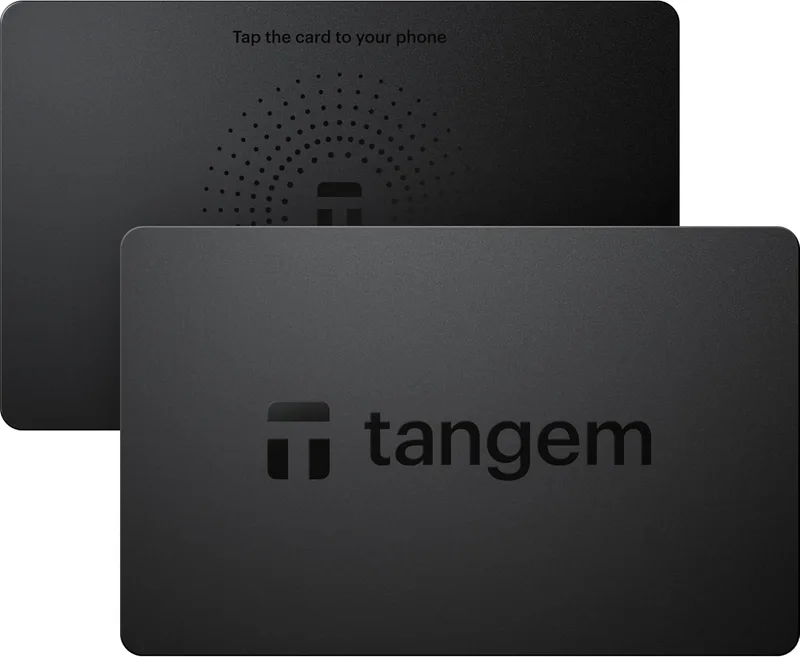
The Tangem Wallet is a genuinely unique hardware wallet that eliminates the seed phrase entirely and fits in your physical wallet like a credit card. Its EAL6+ secure element, IP68 durability, and ultra-low price make it an appealing option for users who find traditional seed phrase management intimidating. However, the lack of a screen means you must fully trust your smartphone to display accurate transaction details, and the closed-source firmware prevents independent security audits. For users who prioritize portability, simplicity, and seedless backup above all else, Tangem is worth considering. For those who want full transparency and on-device transaction verification, a screen-equipped open-source wallet like the Trezor Safe 3 or Blockstream Jade Plus remains the stronger choice.
Design and Form Factor
The Tangem Wallet breaks every convention of what a hardware wallet looks like. Instead of a small electronic device with a screen and buttons, Tangem is a set of credit-card-sized NFC cards. Each card is 85.6 x 54 x 0.8 mm and weighs just 6 grams — identical dimensions to a standard payment card. You can slide it into your physical wallet alongside your debit and credit cards, making it the most portable hardware wallet available by a wide margin.
The cards are IP68 rated for water and dust resistance, meaning they can survive submersion in water and exposure to dust, sand, and dirt. There are no batteries, no charging ports, no USB connectors, and no screens. The cards are entirely passive devices that draw power from the NFC field of your smartphone when you tap them. This passivity is a double-edged sword: it makes the cards extremely durable with a rated chip lifespan of 25 years, but it also means all transaction details are displayed only on your phone.
Security Architecture
Each Tangem card contains an EAL6+ certified secure element chip. Your private key is generated directly on the card during initial setup and never leaves the chip — it cannot be extracted, exported, or viewed. This is the same certification level as the Trezor Safe lineup, providing strong assurance that the hardware resists physical attacks and key extraction attempts.
The most distinctive security feature is the complete elimination of the seed phrase. Traditional hardware wallets generate a 12 or 24-word recovery phrase that serves as the master backup for your private keys. This seed phrase is powerful but also a significant liability: anyone who finds it can steal your funds. Tangem removes this attack vector entirely. Instead, backup is handled by linking multiple cards together. In a 2-card set, both cards hold copies of your private key. If one card is lost or damaged, the other serves as a full backup. The 3-card set provides additional redundancy.
The critical trade-off is the absence of a screen. With a traditional hardware wallet like the Trezor Safe 3 or Trezor Safe 5, you verify the receiving address and transaction amount directly on the device's screen before signing. This protects you even if your computer or phone is compromised by malware that modifies displayed addresses. With Tangem, you rely entirely on your smartphone's screen to show you accurate transaction details. If your phone is compromised by address-swapping malware, you would have no way to detect the manipulation on the card itself.
The firmware is closed-source, which means the security community cannot independently audit the code running on the secure element. Tangem has published third-party audit results from Kudelski Security, but this does not provide the same level of ongoing transparency as fully open-source alternatives like Trezor or Blockstream Jade Plus.
Software and Usability
The Tangem app is available for iOS and Android and serves as the only interface for managing your wallet. There is no desktop application. Setup is remarkably simple: download the app, tap your first card to your phone, create a wallet, then tap your backup card(s) to link them. The entire process takes under five minutes, with no seed phrase to write down, verify, or store securely. For users who find the seed phrase process stressful or confusing, this is a major usability advantage.
Sending and receiving transactions requires tapping a card to your phone, which acts as biometric-style confirmation. The app interface is clean and functional, with built-in support for swapping tokens and purchasing cryptocurrency directly. Portfolio management features are adequate, though the app is not as feature-rich as Trezor Suite or Ledger Live.
The NFC-only communication requirement means you need a smartphone with NFC capability. Virtually all modern smartphones support NFC, but older or budget devices may not. There is no USB fallback. If your phone is unavailable, you cannot access your wallet at all. This is a meaningful limitation compared to USB-connected wallets that can work with any computer.
Coin Support and Features
Tangem supports over 6,000 coins and tokens across major blockchains including Bitcoin, Ethereum, Solana, Cardano, Polkadot, and many others. This is solid coverage for most users, though it trails the 8,000+ coins supported by Trezor devices. The built-in swap feature allows you to exchange tokens directly within the app, and the buy feature supports purchasing crypto with fiat currency.
The wallet supports WalletConnect, enabling you to interact with decentralized applications (dApps) on various networks. Each interaction requires a physical card tap for signing, adding a layer of security to DeFi operations. For Bitcoin-specific users, the feature set is basic but functional: you can send, receive, and view your balance. Advanced Bitcoin features like coin control, replace-by-fee, or Tor integration are not available.
Value and Competition
At $54.90 for a 2-card set or $79.90 for a 3-card set, Tangem is competitively priced. The 2-card set is cheaper than the Trezor Safe 3 at $79 and the Ledger Nano Gen5 at $79, while the Blockstream Jade Plus at $65 sits between the two Tangem options. The SafePal S1 at $49.99 is slightly cheaper but comes as a single device without redundant backup.
The Cypherock X1 at $199 shares Tangem's seedless philosophy but takes a different approach, using Shamir Secret Sharing across a device and four NFC cards. It includes a screen for on-device verification, which addresses Tangem's biggest weakness, but costs nearly four times as much.
Tangem occupies a unique niche: it is the only hardware wallet that combines a card form factor, seedless design, and sub-$60 pricing. If these specific attributes align with your priorities, no other product on the market matches it. If on-device verification and open-source firmware are more important to you, the Trezor Safe 3 or Blockstream Jade Plus deliver those at a similar price point.
For
- ✓Ultra-portable credit card form factor — fits in any wallet
- ✓No seed phrase to lose or protect
- ✓EAL6+ certified secure element
- ✓IP68 water and dust resistant
- ✓Very affordable starting at $54.90 for a 2-card set
- ✓25-year rated chip lifespan
- ✓Built-in swap and buy features in the Tangem app
Against
- ✗No screen — you must trust your phone to display correct transaction details
- ✗Closed-source firmware limits independent security verification
- ✗No desktop support — mobile app only (iOS and Android)
- ✗NFC-only communication requires a compatible smartphone
- ✗No seed phrase means no standard recovery if all cards are lost
Affiliate links · price unchanged for you
Claude
AI crypto agent — searches across the entire internet to analyze specifications, security data, and user feedback, delivering research results based on facts and data.