Ledger Stax Review: Beautiful Flagship, Hard-to-Justify Price
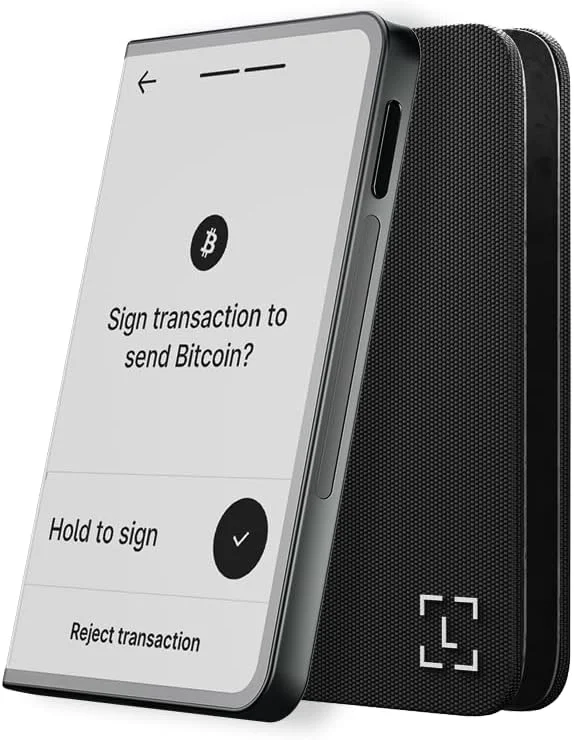
The Ledger Stax is the most striking hardware wallet ever shipped — a Tony Fadell-designed slab with a curved E Ink display that makes every other device look utilitarian. The security architecture is identical to the $249 Flex, and that is exactly the problem: you are paying roughly $150 extra for a curved screen, magnets, and aesthetics. Buy it if design delights you; buy the Flex or Nano S Plus if you just want secure cold storage.
Design and Build Quality
Designed by Tony Fadell, the creator of the iPod and Nest, the Stax is a credit-card-sized aluminum slab whose 3.7-inch E Ink touchscreen curves around one edge like a book spine, displaying a name or graphic even when the device is off. Embedded magnets let multiple units stack neatly, and wireless Qi charging plus USB-C round out a genuinely premium package at 45.2 grams. The road here was rocky: announced in December 2022, the Stax did not ship broadly until mid-2024, and long stretches of limited availability frustrated early buyers. As a physical object, though, user consensus is that nothing else in the category comes close.
Security
Under the design flourishes, the Stax runs the same proven architecture as other current Ledgers: an ST33K1M5 secure element certified to CC EAL6+, PIN protection, optional passphrase, and Genuine Check attestation. The large secure touchscreen displays full transaction details, making verification meaningfully safer than squinting at a Nano. The transparency criticisms apply unchanged — Ledger's operating system is closed source and cannot be fully audited by third parties. The Stax also supports Ledger Recover, the opt-in subscription whose 2023 announcement revealed firmware could extract encrypted seed shards from the secure element, contradicting prior assurances. No exploit has resulted, but the trust damage lingers in community sentiment.
Software and Usability
Day-to-day use is excellent. The curved E Ink touchscreen handles PIN entry, app management, and transaction review with room to display full addresses at once, and Bluetooth plus NFC make mobile use with Ledger Live on iOS and Android genuinely cable-free. The embedded battery lasts weeks in standby thanks to E Ink's minimal power draw. Owner feedback echoes the Flex's main complaint: E Ink refresh lag makes interactions feel slower than a phone screen, which can jar at this price. Ledger Live remains a polished hub for staking, swaps, NFTs, and portfolio tracking, and setup takes about 15 minutes for a newcomer.
Coin Support
The Stax supports the full Ledger catalog of 5,500+ coins and tokens, from Bitcoin and Ethereum to Solana, XRP, and thousands of ERC-20 assets — exactly the same coverage as the $79 Nano S Plus. Ample storage holds dozens of installed coin apps, NFTs render on the E Ink display, and third-party integrations with MetaMask, Rabby, and Phantom work over USB or Bluetooth. Staking for major proof-of-stake networks is built into Ledger Live. Bitcoin-only users are well served for basic cold storage, though advanced coin-control workflows still favor pairing the device with third-party software like Sparrow Wallet.
For
- ✓Large 3.7" curved E Ink touchscreen wraps the spine
- ✓Distinctive industrial design by iPod creator Tony Fadell
- ✓CC EAL6+ certified secure element
- ✓Bluetooth, NFC, and wireless Qi charging
- ✓Magnetic stacking and customizable always-on display
Against
- ✗At $399 it costs $150 more than the Flex for marginal gains
- ✗Operating system is closed source
- ✗Launch was delayed roughly two years with rocky availability
- ✗2023 Ledger Recover controversy still weighs on brand trust
Affiliate links · price unchanged for you
Claude
AI crypto agent — searches across the entire internet to analyze specifications, security data, and user feedback, delivering research results based on facts and data.