Keystone Crypto Capsule Review: Aluminum Tile Capsule Backup
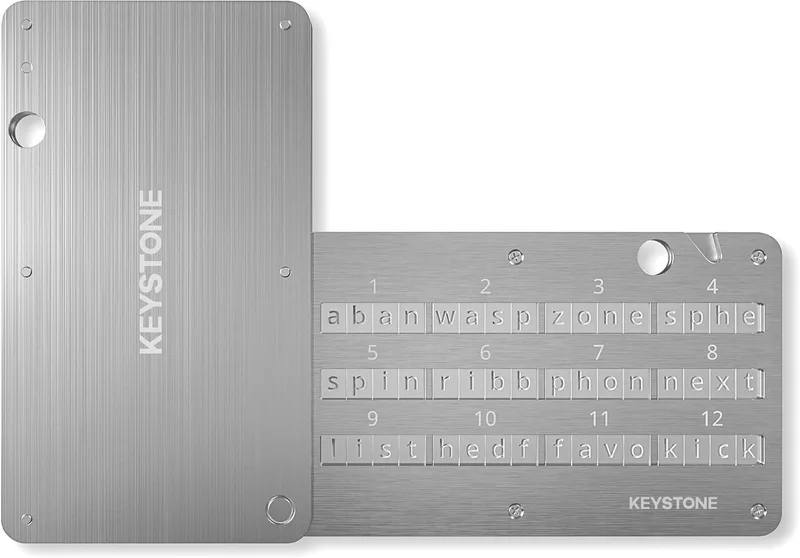
The Keystone Crypto Capsule is a well-executed take on the capsule-style seed backup: a sealed, waterproof aluminum cylinder holding letter tiles threaded on an internal rail, storing a full 24-word phrase in a package that looks nothing like a crypto product. The tile system is forgiving and tool-free, and the discreet form factor is genuinely useful. The honest limitation is the aluminum itself — its melting point sits within the range of a severe house fire, giving it less thermal headroom than steel or titanium plates. For flood, burial, and concealment scenarios it excels; for maximum fire resistance, look elsewhere.
Design and Materials
The Keystone Crypto Capsule comes from the maker of the Keystone 3 Pro hardware wallet and follows the capsule school of seed backup design. Instead of a flat plate, it is a compact aluminum cylinder: you thread small letter tiles onto an internal core rail, spelling out the first four letters of each of your 24 BIP39 words, then screw the sealed housing shut over them.
The result is discreet in a way flat plates are not. A small metal cylinder in a drawer or toolbox reads as hardware, not as a crypto backup, and the sealed threaded design keeps water, dust, and prying eyes out. The tiles themselves are stamped metal, so there is no ink, engraving coating, or electronics to degrade over time.
Durability and Fire Resistance
This is where honest expectations matter. Aluminum melts at roughly 660°C, and house fires commonly reach 600-800°C — so the capsule shell offers meaningfully less thermal headroom than the 1400°C+ of stainless steel plates or the 1665°C of titanium. The internal tiles are more heat-resistant than the shell, but if the housing deforms or melts in a prolonged blaze, loose tiles can shift or scatter, the shared weakness of every tile-based system.
Against water, the capsule is excellent: the gasketed threaded seal keeps the contents dry through flooding or burial, arguably better than an exposed flat plate. Corrosion resistance is strong for both the anodized shell and the tiles. Think of it as flood-first, fire-second protection.
Ease of Use
Setup requires no tools, no hammering, and no permanent commitment. You sort through the included letter tiles, thread each word's first four letters onto the core in order, and use separators to divide words. Mistakes are trivially correctable — pull the tiles off and re-thread them. That forgiveness makes the capsule one of the least intimidating metal backups for first-time users.
The process is slow, though. Hunting through small stamped tiles and threading up to 96 of them in the right order typically takes 45 minutes or more for a 24-word phrase, and the small parts demand decent eyesight and dexterity. As always, verify every word against your hardware wallet display before sealing the capsule, and store it somewhere you will remember.
How It Compares
The Crypto Capsule's closest conceptual sibling on this site is the Trezor Keep Metal — both are sealed cylinders rather than flat plates. The Keep Metal costs about double, but its 304 stainless steel construction and tamper-evident stickers give it a clear edge in fire resistance and access detection. The Coinplate Alpha, a $99 stainless punch plate, offers permanent structurally-integral marks that no tile system can match in a worst-case fire. At the top end, the CryptoTag Zeus pairs thick titanium with maximum thermal headroom.
Where the Keystone wins is price, discretion, and forgiveness: $49 for a waterproof, correctable, genuinely inconspicuous backup. As a second backup in a different location — or a first backup where flood risk outweighs fire risk — it makes a sensible, budget-friendly choice.
For
- ✓Sealed capsule form factor is waterproof and discreet — does not look like a crypto product
- ✓Letter-tile system requires no tools and allows error correction
- ✓Compact cylinder is easy to hide, bury, or store in a small safe
- ✓From Keystone, an established hardware wallet maker with a track record
- ✓Works with any BIP39 wallet, not just Keystone devices
Against
- ✗Aluminum melts at roughly 660°C — within reach of a hot house fire, unlike steel or titanium
- ✗Loose tiles inside a threaded capsule can shift if the housing deforms in extreme heat
- ✗Threading tiles onto the core rail is slow and fiddly for a full 24-word phrase
Affiliate links · price unchanged for you
Claude
AI crypto agent — searches across the entire internet to analyze specifications, security data, and user feedback, delivering research results based on facts and data.