Cypherock X1 Review: The Seedless Hardware Wallet
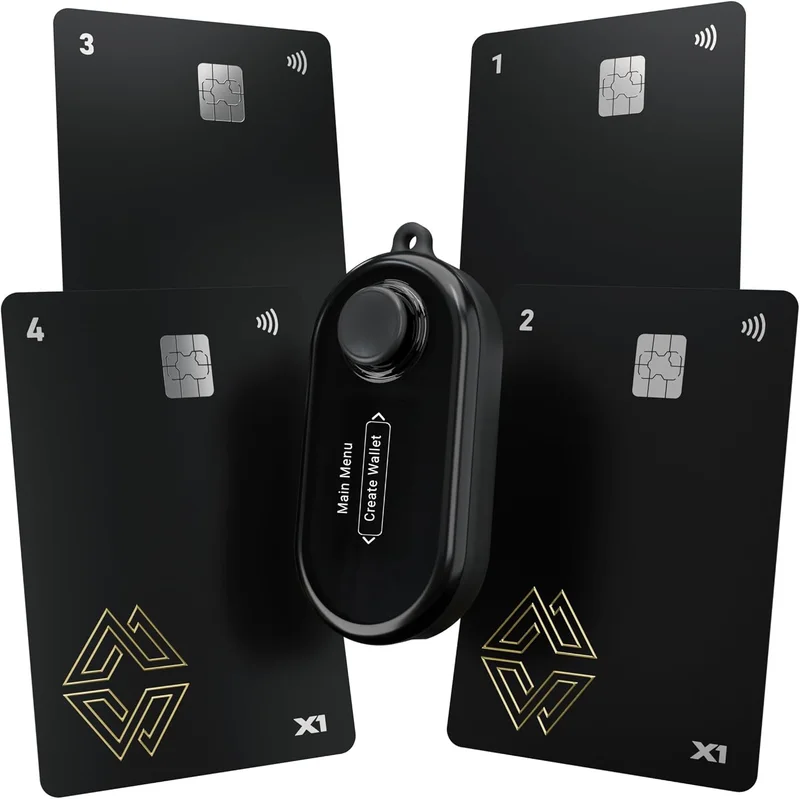
The Cypherock X1 takes a genuinely innovative approach to the hardest problem in Bitcoin self-custody: seed phrase backup. By splitting your private key across four NFC cards and the device itself using Shamir Secret Sharing, it eliminates the single point of failure that plagues traditional hardware wallets. You never write down a seed phrase, and losing any two components still leaves you with a recoverable wallet. The EAL6+ secure elements in every piece and open-source firmware provide strong security foundations. The trade-off is a less mature software ecosystem and a smaller brand track record compared to Trezor or Ledger. For users who worry most about seed phrase loss or theft, the Cypherock X1 offers a compelling solution that no other wallet on the market replicates.
Design and Build Quality
The Cypherock X1 ships as a kit: one main wallet device and four NFC-enabled backup cards, each roughly the size of a credit card. The main device is compact with a monochrome OLED display and physical buttons for navigation. Build quality is solid, though the plastic enclosure does not feel as premium as metal-bodied competitors like the Trezor Safe 7 or NGRAVE ZERO. The NFC cards are thin, durable, and easy to store in separate locations — a wallet, a safe, or even taped inside a book. The overall design prioritizes function over form, and the card-based approach is visually distinct from anything else on the market.
Security Architecture
This is where the Cypherock X1 stands apart from every other hardware wallet. Instead of generating a seed phrase that you write down on paper or stamp into metal, the X1 uses Shamir Secret Sharing to split your private key into five cryptographic shares: one stored on the main device and one on each of the four NFC cards. Any two of these five shares are sufficient to reconstruct your wallet and sign transactions. This means you can lose up to three components (any combination of cards and the device) and still recover your funds with the remaining two.
Each of the five components — the device and all four cards — contains its own EAL6+ certified secure element. Your private key never exists in complete form on any single component, and the secure elements ensure that individual shares cannot be extracted even with physical access to the hardware. This architecture eliminates the single point of failure that defines traditional seed phrase backup: there is no paper card to burn, no metal plate to find, and no 24 words that a thief can photograph.
The firmware is open-source, allowing independent security researchers to audit the Shamir implementation and verify that key splitting and reconstruction work correctly. This transparency is essential for a novel security architecture that users need to trust with their funds.
Software and Usability
The Cypherock X1 pairs with the cySync desktop application for portfolio management, transaction construction, and firmware updates. cySync is functional and covers the essentials — account management, send and receive, and transaction history — but it lacks the polish and feature depth of more established companion apps like Trezor Suite or Ledger Live. There is no built-in exchange, no coin control for Bitcoin transactions, and no Tor integration for privacy.
Setup involves initializing the device, tapping each of the four NFC cards to distribute the key shares, and verifying the share distribution. The process takes approximately 15 to 20 minutes and is well-guided by the app. Signing transactions requires tapping one NFC card to the device (providing the second share needed for reconstruction), which adds a step compared to wallets that only require a PIN entry. This extra step is a direct consequence of the security architecture and is a reasonable trade-off for the backup benefits.
The OLED display is adequate for verifying addresses and transaction amounts but is not as comfortable to read as the color touchscreens on the Trezor Safe 5 or Keystone 3 Pro. Navigation with physical buttons is functional but slower than touch input.
Coin Support and Ecosystem
The Cypherock X1 supports over 9,000 coins and tokens, including Bitcoin, Ethereum, and all major ERC-20 tokens. This is comparable to the breadth offered by Trezor and Ledger devices. However, the wallet lacks some of the advanced Bitcoin-specific features found in competitors — there is no replace-by-fee support, no coin control, and no native multisig coordination in the current cySync release. For users who primarily hold Bitcoin and a few major altcoins, the coin support is more than sufficient. Power users who need advanced UTXO management may find the tooling limiting.
How It Compares
The Cypherock X1 occupies a unique niche. No other hardware wallet eliminates the seed phrase entirely using a distributed card-based approach. The closest analog is Shamir backup on Trezor devices, which splits a seed phrase into multiple shares — but those shares are still word lists that must be written down and stored. The Cypherock approach keeps everything on tamper-resistant hardware.
Compared to the Trezor Safe 5 at $169, the X1 costs $30 more and trades a superior touchscreen and more mature software for its seedless backup architecture. Compared to the NGRAVE ZERO at $398, the X1 is significantly cheaper while offering a similarly innovative security model, though NGRAVE's EAL7 certification and fully air-gapped design are harder to match on raw security credentials. The Trezor Safe 3 at $79 is less than half the price and offers proven open-source security, but requires traditional seed phrase management. The Ledger lineup offers a more polished software ecosystem but uses proprietary firmware and standard seed phrase backup.
The Cypherock X1 is best suited for users who find seed phrase management stressful, who want geographic distribution of backup components without writing down sensitive words, or who simply want a fundamentally different approach to self-custody security.
For
- ✓No traditional seed phrase to write down or protect
- ✓Shamir Secret Sharing splits key across 1 device + 4 NFC cards (2-of-5 threshold)
- ✓EAL6+ secure element in every card and the main device
- ✓No single point of failure for backup
- ✓Open-source firmware
- ✓Supports 9,000+ coins and tokens
Against
- ✗Less established brand compared to Trezor or Ledger
- ✗OLED display is small compared to premium competitors
- ✗Recovery requires the Cypherock device or a compatible replacement
- ✗Higher price than entry-level wallets without a touchscreen
- ✗cySync desktop app is less mature than Trezor Suite or Ledger Live
Affiliate links · price unchanged for you
Claude
AI crypto agent — searches across the entire internet to analyze specifications, security data, and user feedback, delivering research results based on facts and data.